Wednesday, 9 March 2011

How to build a tensegrity octahedron

Besides icosahedra, octahedra can be build to collapse and bounce back. If you use just elastic cords, the model has high mobility, yet I noticed that the cords slide sometimes to easy around in models with just elastic cord. I use elastics for the six 'corner' loops, and nylon for the remaining twelve tendons. 

The less stretchy nylon helps to maintain the overall shape after a collapse. The different materials indicate their function in a 'solid' octahedron: The edges turned into the nylon cords, the corners folded open into a square loop made of elastic cord. 

The nylon cord has a length of 7cm between the knots (made from 10cm cuts), the elastic cord has a length of 30cm tied to a loop. As I loop the the elastic cord around the grooves to secure their position, the effective length between struts comes down to 6cm. The struts itself measure 16cm, with 15 cm between attachment points.
Components for the model

I aim for precision when I prepare the components for a model, yet symmetrical models can do with a bit of variation in length. With a lot of a variation in tendon or strut length, the model looks less symmetrical, it still works as tensegrity system. 

So it starts from 12 struts (15cm effective compression), 6 loops made from elastic cord, 12 tendons made from nylon. The four 'horizontal' edges will be yellow, the eight vertical ones will be orange. Different colours for different functional elements make it easier to keep organised while the model is still two-dimensional.
Step 1: Attaching the tendons

In the finished model, each strut is connected to two tendons and member of two 'corner loops'. To prevent the tendons from slipping out, they get attached first. Four struts get a 'vertical' and 'horizontal' edge attached, four struts get the remaining four verticals and four remain empty.

Step 2: The bottom corner

The struts with only vertical tendons end up in the bottom of the model. The struts are connected into a loop on the end with the tendon, so that the knots point to the 'inside' of the loop, the longer end goes away from the loop. (This means that if the struts fold over clockwise, the knot will be clockwise towards the strut as well). I start usually with the opposing corners, so that I can always half the tendon when connecting an additional strut. The elastic is looped around the groove once to secure it in place. 

Step 3: The top corner

The top corner is assembled in the same way - connecting four struts at the end with the vertical (orange) tendons, knots points inside, tendons to the outside. All corner need to fold with the same chirality, ie clockwise or counterclockwise. If you lay the top corner above the bottom corner, the yellow tendons should already point to the strut of the bottom corner it connects to.

Step 4: Connecting top and bottom corners with horizontal tendons

Depending on the length of the struts, and the tightness of fit of the cords and grooves, a lot of slipping and sliding can happen while connecting top and bottom corners. Once we yellow tendons were in place, I took care that the loops didn't get entangled. At this stage, the struts hold each other up, like in the match head trick. 

Step 5: Connecting top and bottom corner with remaining corners

This step unveils the precision of planning and preparing of this process. With a good loop length, the model will start to erect itself, becoming three-dimensional and easing the following steps. The inside-outsideness of the remaining corners is still more of an up-downness when the elastic are connected. The inside of the loops goes along the bottom half of the bottom corner strut, and the top half of the top corner strut. If the struts still fold over un-entangled, the top corner starts pushing up the more corners connect to it. Now it's a good time to check that the free ends of the vertical tendons hang in a decent direction.

 Step 6: Connecting the remaining struts to the tendons

Over and under become more important now, and make life easier at the same time. The remaining struts connect between a bottom and top. Each strut goes under a top corner strut, attaches to the bottom corner tendons on the strut in the same direction as in the top corner. It attaches also the top corner tendon of the top corner strut that runs parallel to the one crossed under. (I wonder if this description makes any sort of sense unless you starting these three-dimensional puzzles yourself).

If all worked fine, the top end of the newly connected strut pull on the top corner and float a bit. 

Step 7: Connecting the top part of the middle corners

A lot of movement will happen now. only eight connections finalise the model. Depending on how much uncontrolled movement happens, the model might fall apart or become lose. Working patiently with a steady hands prevents the frustration that arises from the anticipation of success and the sight of an entangled mess of sticks and strings. Like with the other loop connections, the knot of the tendon need to point in the same direction as the other struts in the loop.

Step 8: Connecting the bottom part of the middle corners

If the cords can slide easily, this step can become tricky. If the tendons and loops are too short, the model might 'fly apart', with too long cord lengths the model will still lay collapsed in a pile. Once the remaining connections are made, I take some time to 'tune' each corner. It's more likely to have some trapezoidal corners instead of nice squared ones. If struts were accidentally 'twisted' during build, they can be turned into the proper direction, so that each corner looks similar (all knots oriented the same way, elastic cords length equally from strut to strut.

Step 9: Test

Now the model can be loaded to collapse. With too long loops, a model might still look like this - well, a bit more chaotic as the elastic string would dangle around somewhere. That happened to me with the very first octahedron I build. I went from corner to corner and looped the elastic several times around each corner, and slowly the structure started 'working'. With sufficient pre-tension the model can be handled and tuned easily, and minor hick-ups during the build process corrected.

Sorry for mixing up the photos - two of the steps show a different octahedron. Anyway, if you happened to notice this error it's about time to start building tensegrities. 


Thursday, 3 March 2011

Triple Y


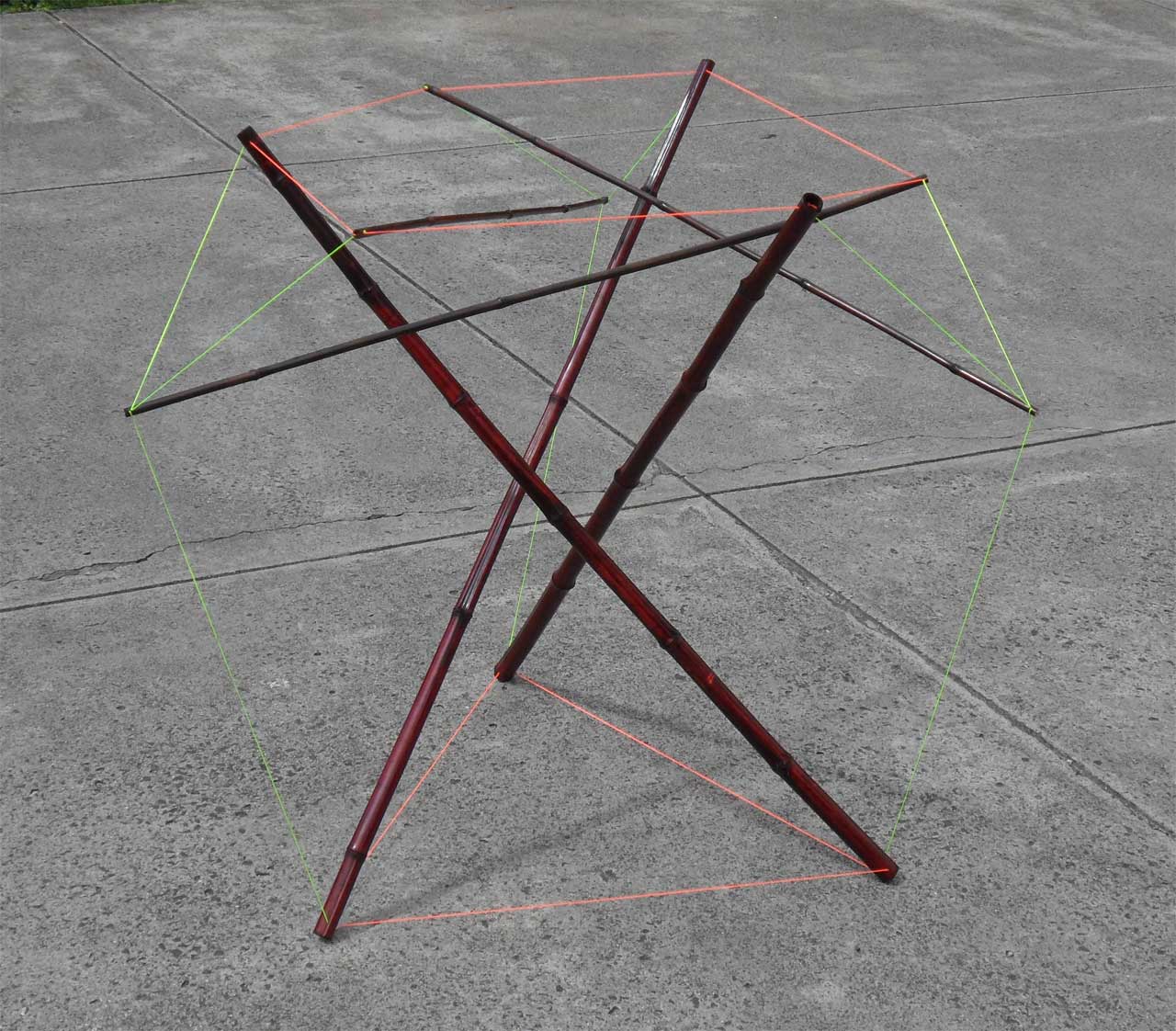
I used wide bamboo struts as basis for a large tetrahedron, which fills nearly a cubic metre in total. The build posed a variety of challenges, with some set-backs on the way. I diverted from my initial plan to build a tetrahedron with 3 clockwise and 1 anti-clockwise corner, although I know think the way I finished the build could work for this 'deviant' tetra as well.

I drilled three holes at either end of the base struts. The holes are less equidistant than I hoped for, if I reuse the method I need find an easy and precise marking method. The variety in diameter meant as well that pre-calculating tendon lengths made little sense, especially as I used 25% shorter struts for the 'floating struts'.

I knew from my first build using holes for the tendon attachment often ends up very difficult. I need to pull the tendon out for some length to tie a knot, it's no fun to do this when the structure is nearly ready. As I planned to use grooves to attach the smaller struts, I just need to find a way to attach the tendons while minimising the amount of 'final tendons'.

By analysing other tetra models I noticed a way to build first a (very slack) 3-strut tensegrity, and then thread the remaining struts first in upper triangle, then in the vertical tendons. In theory, this works well, yet only the base triangle kept its initial length. The failed build attempts convinced me of the feasibility of this approach, and with another intuitive shortening of most tendons I ended up with a stable structure.

The colours join base triangle and top hexagon, the more vertical tendons shape the letter 'y', hence the name Triple Y. It balances on all corners, yet the design favours the biggest triangle as base. Plucking the tendons produces a range of sounds, and quite unpredictable patterns of movement. The sculpture fills about a cubic metre of space with a triangle, a hexagon, three 'y's and six uniquely shaped bamboo struts.

Sunday, 27 February 2011

Diaspora

My sculptures have conquered already three continents, even without me sending them per mail off-shore. The furthest I posted so far is Queensland, some have found a home in Germany, one in Greece, one in India and soon one in Switzerland. Most of them will be scattered around the greater Melbourne area, quite some of those in good use as demonstration objects.

Fossilised bio-material, millions of year old, provided the oil needed to produce the tension elements and transport the materials into my home. The bamboo grew most likely in China, processed, packaged and sent to Australia. At least I started lately to use my unicycle for shopping trips when possible to keep the energy-consumption of my home-made products low. Only one essential production-step involves electricity, the rest consists of purely manual effort.

Mass-production distracts from the idea of tracing the origins of a product. In a consumer-society, the life cycle of products remains unknown, sometimes even for good reasons. Hand-made products existed throughout history whenever the social organisation enabled 'economy'. In our globalised world, we got used to have a similar range of products, at least Maccas and Coca-Cola reached nearly everywhere.

A mass-producer has usually a well-organised distribution infrastructure in place, while I just have a point of sale twice a month, in an obscure location in funky Fitzroy. I love the variety of products in the Rose Street Artist's Market, it's a place that invites to do much more than just shopping. It brings back fair trade (not the trademarked one) in the sense of no involvement of middle men.

I'm still torn whether to call the objects undergoing a commercial transaction 'product' or '(art) work'. I build some models a conscious artistic attitude, others belong more to the 'fun in making and playing with' category. My main intention in producing tensegrity structure lies in spreading the tensegrity meme.

The information about tensegrity travels faster via the internet, yet I consider materialised structures more appealing. Models help understanding in an embodied way, instead of simply processing ideas and pictures. My sculptures fill space with lightness and delicate balance, yielding to force before returning into shape. Three continents in less than a year makes me happy and determined to continue my exploration into the lightness of movement and balance.

Saturday, 19 February 2011

Little changes

I can now maintain some static pages within this blog which makes me real happy. Instead of cluttering images of the sculptures wildly over some disconnected pages, you can find my portfolio now via the menu, as well as the market dates in case you want to see (and touch) ma things. This means I can give this site a much more organised appearance than I ever hoped for, unless bouts of laziness delay my impeccable intentions.

And finally, the blog can fulfil its destiny and deal with stories and infos about the process of bringing tensegrity structures to live.

Thursday, 13 January 2011

How to build a tensegrity icosahedron

The model I sold most so far is a simple 6-strut icosahedron with elastic string. It can collapse entirely and bounces back fiercely afterwards. The cord is much more durable than rubber bands, my favorite product tester is my neighbour's son, who hasn't manage to destroy his toy for more than half a year now.

The bamboo sticks I used have a diameter of 5mm, with a 1mm wide groove at either end. The elastic cord has a diameter of 0.8mm, the knot prevents the string from sliding out of the groove, especially once the model is fully assembled. The tension level can be increased by looping the cord more than once, but unless you will do with all connections the symmetry can be compromised.

Tuesday, 11 January 2011

Slideshow

Here's a little slideshow with most of the models for 2011. Enjoy.

Wednesday, 5 January 2011

Market Dates

I just confirmed my bookings for the Rose Street Artist's Market for January and February. Keeping up my old habits, I will appear fortnightly on Sundays in Fitzroy, offering you the unique opportunity to buy an original piece of tensegrity art.

  • January: 16 and 30
  • February: 13 and 27

     Red white delight
    Tensegrity Octahedron (12 struts)

     Halfcast
    Tensegrity Octahedron mounted on 4-strut tensul (12 + 4 struts)

     Red Barrier
    Tensegrity Icosahedron (6 struts)

     Hope
    Tensegrity Tetrahedron (6 struts)

     Redfaced
    Tensegrity Vector Equilibrium (24 struts)

     Tensultower
    Five stacked 3-strut tensuls (15 struts), ca 130 cm high

    Copperhead
    Tensegrity Tetrahedron mounted on a tensul (6 + 3 struts), ca 160 cm high


    Tetroid
    Tensegrity Tetrahedron (6 struts)